Stocks Return to Record Highs as Earnings Season Arrives
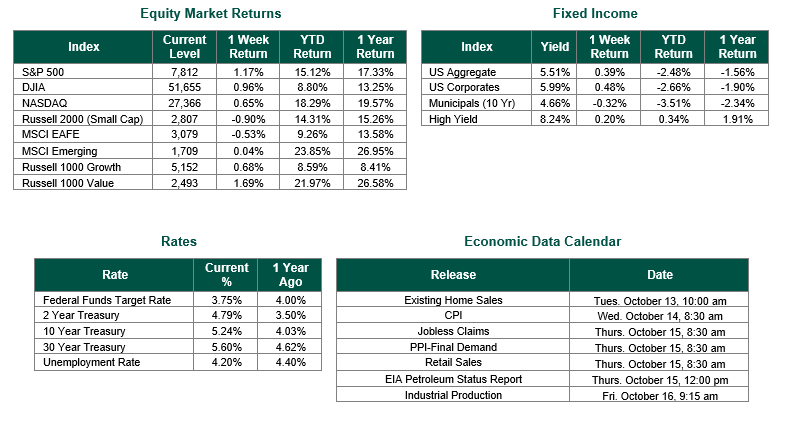
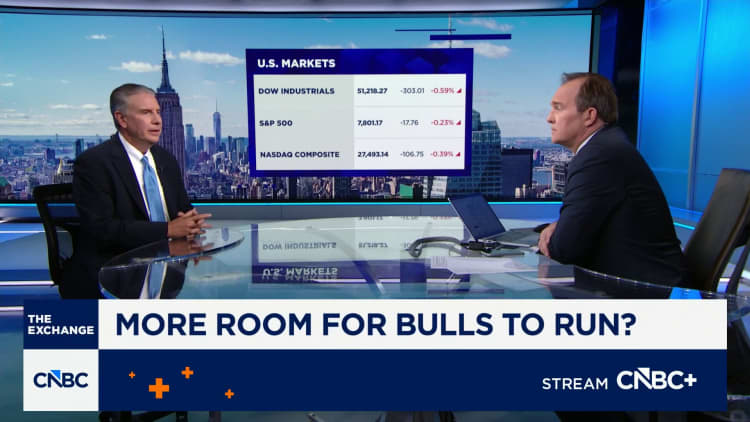
Global equity markets finished mixed for the week. In the U.S., the S&P 500 Index closed the week at a level of 7812, representing an increase of 1.17%, while the Russell Midcap Index moved +1.42% last week. Meanwhile, the Russell 2000 Index, a measure of the Nation’s smallest publicly traded firms, returned -0.90% over the week. As developed international equity performance and emerging markets were mixed, returning -0.53% and +0.04%, respectively. Finally, the 10-year U.S. Treasury yield moved lower, closing the week at 5.24%.
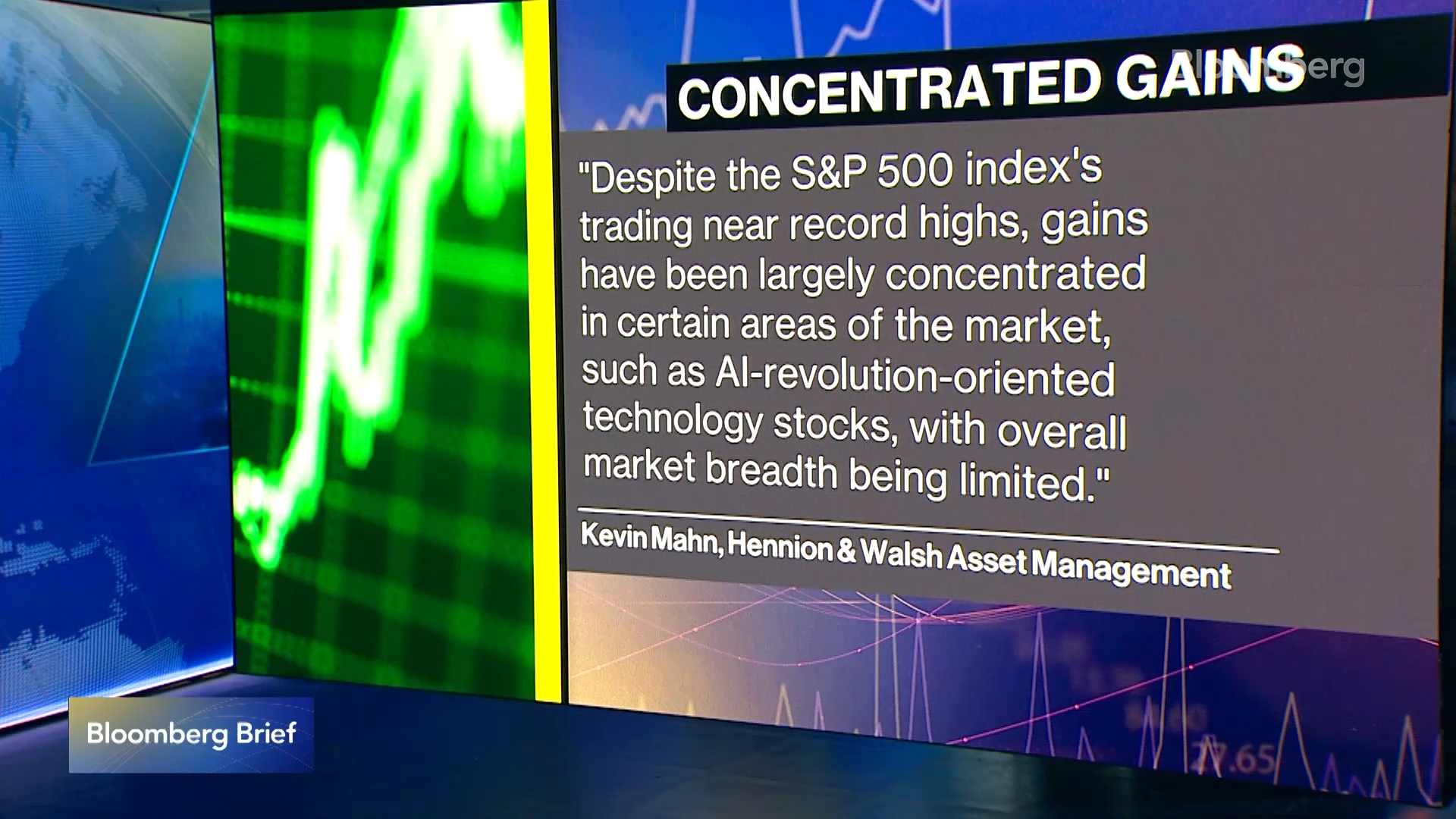
U.S. stocks returned to record territory last week. The S&P 500 Index closed at an all-time high on Tuesday for the first time since mid-August and finished Friday just below that mark. Beneath the surface, leadership looked very different from what investors have grown used to this year. Utilities, energy, consumer staples and health care led the way, while information technology and industrials slipped modestly. The tech wobble came on Thursday, when the Financial Times reported that OpenAI’s annualized revenue was running roughly $20 billion below what had previously been signaled, resulting in semiconductor and memory stocks trading sharply lower. OpenAI reaffirmed its prior expectations and the largest technology names rebounded on Friday. Still, the episode was a reminder that the capital markets remain highly sensitive to any sign that AI revenues are not keeping pace with the enormous sums being invested in the AI infrastructure buildout.
The bond market once again took center stage last week. Early in the week, the 10-year U.S. Treasury yield climbed to nearly 5.37%, its highest level since 2002. Then the tone changed. Treasury’s $39 billion 10-year note auction priced at 5.30%, the highest auction yield since November 2000, yet it still cleared below where the market expected, a sign that investors, and not just dealers, were stepping in to buy Treasuries. By Friday, the 10-year yield had settled slightly below where it began the week, and the Bloomberg U.S. Aggregate Bond Index snapped a streak of five consecutive weekly losses. The Federal Reserve offered little relief. Minutes from the September 15–16 FOMC meeting showed that most participants believed another increase would likely be appropriate by year end, and Fed Governor Christopher Waller said on Thursday that he anticipates additional hikes, though “the hikes do not need to come at consecutive meetings.” Markets appear to agree. According to the CME Group FedWatch Tool, the probability of a hike at the October 27–28 meeting stood near 18% at the end of the week, while the probability of an increase by December was roughly 83%. The auction results could suggest that yields above 5% are beginning to attract patient, long-term buyers, even with the Fed still leaning toward tightening. However, it should be noted, that these Fed meeting minutes were formulated before recent updates on the labor and inflation fronts.
Economic data painted a picture of a consumer growing frustrated with high prices. The University of Michigan’s preliminary October consumer sentiment index fell to 46.3 from 48.1, a five-month low, while the New York Fed’s Survey of Consumer Expectations showed median one-year inflation expectations rising to 3.9% in September, the highest reading since May 2023. With gasoline still above $4.30 per gallon, the frustration is easy to understand. Oil itself finished the week little changed, with West Texas Intermediate crude near $92 per barrel and Brent crude oil near $104. Attacks on tankers around the Strait of Hormuz and Hurricane Isaias, which shut in more than one million barrels per day of Gulf of Mexico output, were offset by a G7 agreement to release 100 million barrels of emergency crude and diesel stocks. Businesses are apparently feeling the squeeze too. The prices index in the ISM Services PMI climbed to 74, its highest level since July 2022, and Delta Air Lines trimmed its full-year profit outlook, citing high fuel prices. On a brighter note, initial jobless claims fell to 197,000, their fifth straight weekly decline, a sign that layoffs remain low even as hiring has cooled.
This week, the focus shifts to third quarter earnings season and a key new report on inflation. JPMorgan Chase, Goldman Sachs, Citigroup and Wells Fargo kick things off on Tuesday, followed by Bank of America and Morgan Stanley on Wednesday and Taiwan Semiconductor on Thursday. According to FactSet, the S&P 500 is expected to report year-over-year earnings growth of 29.6% compared to the same quarter last year, which would mark the third consecutive quarter of earnings growth above 25%. Even so, the index’s forward P/E ratio of 19.1 remains below its five-year average of 19.8, which reflects just how strong earnings growth has been. On the economic front, Wednesday’s September Consumer Price Index (CPI) will be the last major inflation reading before the October 27–28 FOMC meeting. Consensus expectations call for headline inflation to rise to roughly 3.7% year-over-year from 3.4%, driven largely by gasoline prices, with core inflation expected to hold near 2.4%.
As a reminder, the bond market is closed today in observance of Columbus Day, while stock markets are open. Best wishes to all for the week ahead!
Equity and Fixed Income Index returns sourced from Bloomberg on 10/09/26. FOMC minutes and Governor Waller’s remarks are sourced from the Federal Reserve. Consumer sentiment data is sourced from the University of Michigan Surveys of Consumers. Consumer inflation expectations are sourced from the Federal Reserve Bank of New York Survey of Consumer Expectations. The ISM Services PMI is sourced from the Institute for Supply Management. Jobless Claims were sourced from the U.S. Department of Labor. Earnings estimates and valuation data are sourced from FactSet. Future interest rate probabilities are sourced from CME Group FedWatch. International developed markets are measured by the MSCI EAFE Index, emerging markets are measured by the MSCI EM Index, and U.S. Large Caps are defined by the S&P 500 Index. Sector performance is measured using the GICS methodology.
Disclosures: Past performance does not guarantee future results. We have taken this information from sources that we believe to be reliable and accurate. Hennion and Walsh cannot guarantee the accuracy of said information and cannot be held liable. You cannot invest directly in an index. Diversification can help mitigate the risk and volatility in your portfolio, but it does not ensure a profit or guarantee against a loss.