Mid-Term Elections and Market Timing
Kevin Mahn, Chief Investment Officer
August 19, 2026
With mid-term elections coming up in November, I thought it appropriate to remind investors of the historical impact of mid-term elections on the stock market and the dangers of trying to time the market.
Let’s start with mid-term elections. According to Fidelity, in an article entitled “The Surprising Truth About Midterms and Stocks,” midterm election years have historically been associated with weaker market returns and higher volatility, followed by a year of stronger returns. The first part of that summary has essentially been proven wrong thus far in 2026 as the stock market, as measured by the S&P 500 Index, has experienced a total return of 14.52% as of 8/14/26 and downside volatility has been somewhat subdued overall (although higher than what took place last year) as there have only been 7 days thus far in 2026 where the stock market has moved 1.5% or lower in a given day – that’s just 4.5% of the time!
In terms of the second part of the Fidelity summary, time will tell, but if history serves as a guide, better days may be ahead for the stock market. According to this Fidelity article, stocks have usually risen in the 12 months after an election with an average return of 14.5%, but not always, as represented by their graphics below.
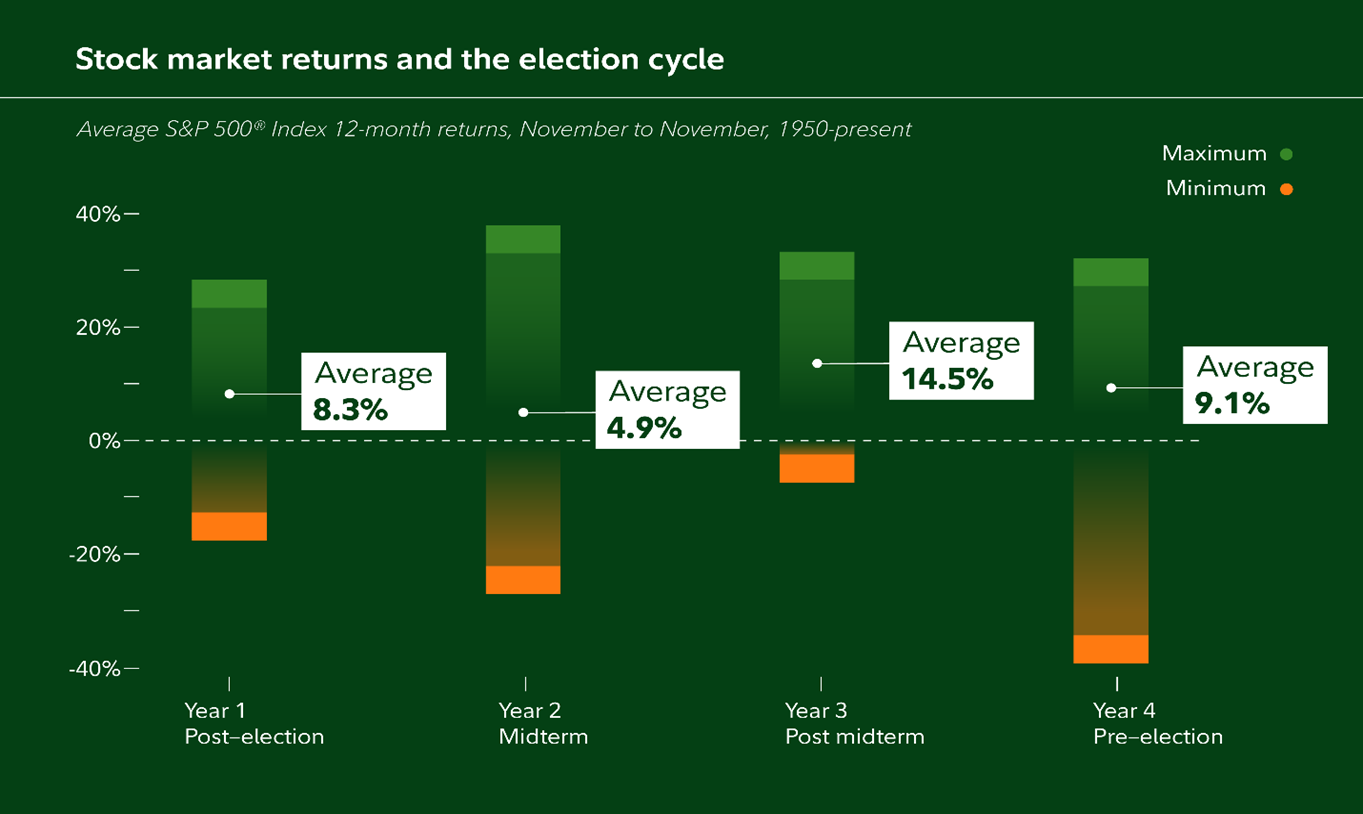
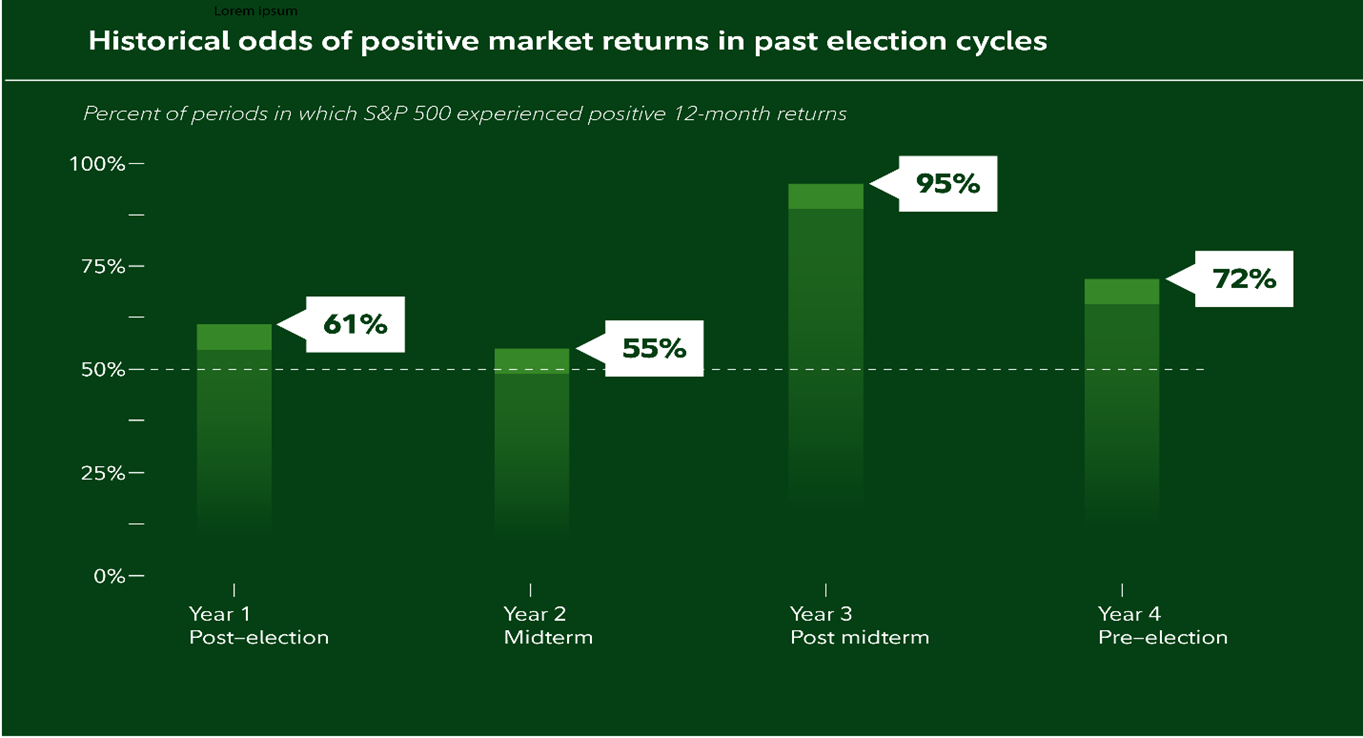
Source: Haver Analytics and Fidelity Investments. Past performance is not a guarantee of future results.Methodology: Based on historical S&P 500 returns from 1950 to the present by election-cycle year. “Odds” represents the percentage of instances that the market went up (number of times the market went up divided by the total number of instances).
The typical rise in the stock market following a mid-term election is likely due to the certainty that the outcome provides as well as the typical ensuing political gridlock. Historically, the political party controlling the White House tends to lose congressional seats in midterm elections, increasing the likelihood of divided government, and creating political gridlock. Investors tend to benefit from divided governments as there is a lower likelihood of any significant policy changes being implemented.
My takeaway: There is no consistent response by the stock market to mid-term elections, regardless of the political party dynamics, and while the uncertainty of the results, and associated policy implications, may create short-term bouts of volatility, they should not serve as a basis for making longer-term investment decisions.
Now let’s tackle the dangers of trying to time the market. During periods of uncertainty, such as mid-term election years, and heightened periods of downside volatility, some investors may choose to try and time the market by moving to cash and later moving that cash back into the market when they believe the “time is right.” History suggests that moving to the sidelines and thereby abandoning your financial and investment plans even if for just a short-term period of time, may be a short-term decision with long-term consequences on an investment portfolio. According to Hartford Funds in an article entitled, “Timing the Market is Impossible,” for the time-period of 1996-2025, if an investor missed the market’s 10 best days over this 30-year period, their returns would have been cut in half.
Furthermore, missing the best 30 days would have reduced their returns 84%! See the graphic below for more details.
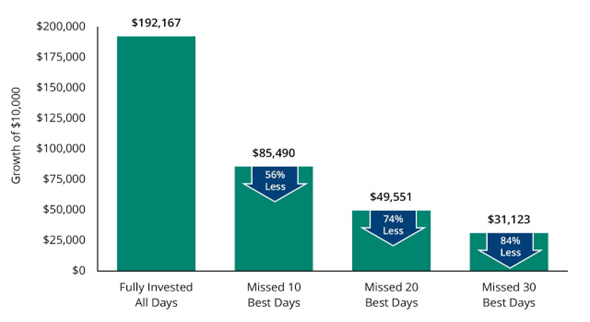
Data Sources: Ned Davis Research, Morningstar, and Hartford Funds, 3/26.Past performance does not guarantee future results. For illustrative purposes only.
These historical data results underscore the potential risk involved in trying to time the market. Even if an investor is able to avoid some down days, they are likely to miss out on some of the most significant returns following these down days that the stock market may have to offer. Consider that, according to JPMorgan Asset Management research, as cited in a CNBC article entitled, “Selling out during the market’s worst days can hurt you, research shows — here’s how much you could lose,” 7 of the 10 best days in the stock market over the past 20 years happened within two weeks (14 to 15 days) of the 10 worst days.
My takeaway: TRYING TO TIME THE MARKET is often an exercise in futility because an investor has to get it right twice – once when they get out of the market and then again when they get back into the market. It is the latter that is the most difficult to achieve and generally has the most risk in terms of opportunity cost. Rather than trying to time the market, TIME IN THE MARKET can often lead to more desirable longer-term financial results, provided, of course, that an investor’s portfolio is constructed, and maintained, consistent with their goals, risk tolerance, and investment timeframe.
I hope all of this is beneficial as you and your clients try to keep the upcoming mid-term election cycle in perspective. Please do not hesitate to reach out to our team here at SmartTrust® if you have any questions or we can provide any additional support.
Market commentary is for informational purposes only. The information contained in our market commentary is not intended as investment advice, endorsement, or recommendation of any particular security, financial product, transaction, or strategy. While we strive to provide accurate and timely information, we do not guarantee the accuracy, completeness, or reliability of any information provided in our market commentary. Market conditions can change rapidly, and information may become outdated or inaccurate. All content in our market commentary, including text, graphics, and other materials, is protected by copyright laws. Reproduction, distribution, or unauthorized use of any content without our prior written consent is prohibited. Indexes are unmanaged, do not incur management fees, costs, and expenses. You cannot invest directly in an index. Investing involves risks, including the potential loss of principal. Past performance is not indicative of future results. Any investment decisions made based on information provided in our market commentary are made at your own risk.
Hennion & Walsh Asset Management currently has allocations within its managed money program, and Hennion & Walsh currently has allocations within certain SmartTrust® Unit Investment Trusts (UITs) consistent with several of the portfolio management ideas for consideration cited above.
Investing involves risk, including loss of principal. To determine if a Trust is an appropriate investment for you, carefully consider the Trust’s investment objectives, risk factors, charges, and expenses before