Inflation Sparks Fed Rate Hike Expectations
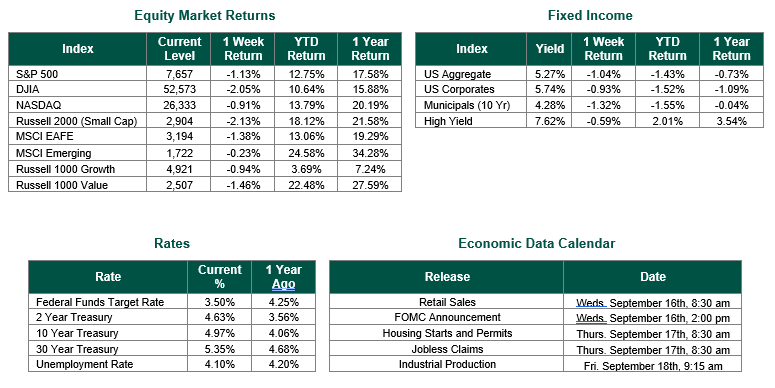
Global equity markets finished lower for the week. In the U.S., the S&P 500 Index closed the week at a level of 7657, representing a decrease of 1.13%, while the Russell Midcap Index moved -2.05% lower last week. Meanwhile, the Russell 2000 Index, a measure of the Nation’s smallest publicly traded firms, returned -2.13% over the week. As developed international equity performance and emerging markets were positive, returning -1.38% and -0.23%, respectively. Finally, the 10-year U.S. Treasury yield moved higher, closing the week at 4.97%.
The economic data released last week has intensified pressure on the Federal Reserve, revealing a complex backdrop of stubborn inflation pressures and challenging consumer morale. Headline inflation metrics moved higher, driven by energy costs, while forward-looking consumer confidence plunged near historic lows. This mixed batch of data has set up a high-stakes scenario for the upcoming Federal Open Market Committee (FOMC) meeting, skewing market expectations heavily toward the expectations of a rate hike of 25 basis points.
The week’s inflation data began on Thursday with the release of the August Producer Price Index (PPI). Headline wholesale inflation rose by 0.4% month-over-month, matching consensus estimates, but accelerated significantly to 5.4% on a year-over-year basis. This annual print outpaced market expectations of 5.3% and marked a steep jump from the 4.8% recorded in July. The acceleration was driven by a 4.2% surge in energy prices, fueled by geopolitical tensions with Iran, which caused diesel prices to skyrocket by 24.1%. Conversely, core PPI, which excludes volatile food and energy components, offered a rare silver lining by climbing 0.2% month-over-month, slightly softer than the 0.3% forecast by economists.
The primary catalyst for market repricing arrived on Friday with the August Consumer Price Index (CPI), which confirmed that wholesale price pressures are bleeding into retail costs. Headline CPI climbed 0.4% month-over-month and 3.4% year-over-year, reflecting sticky price pressures across the broader economy. More concerning for policymakers was the core CPI reading, which strips out food and energy. Core consumer prices increased 0.3% month-over-month, hot against the consensus estimate of 0.2%, and brought the year-over-year core inflation rate to 2.4%. This failure to continue an inflation deceleration pattern effectively compromised the data-dependent threshold established by several central bank officials, solidifying the realization that underlying inflation continues to remain well above the Fed’s 2% target rate.
Labor market data released alongside the wholesale inflation numbers pointed to continued structural resilience. Initial jobless claims for the week were a seasonally adjusted 206,000. This print hovered just above the consensus forecast of 205,000, effectively maintaining a prolonged trend of historically low layoff counts. Coupled with the previous week’s nonfarm payrolls report showing 162,000 jobs added in August, the low jobless claims figures confirm that the labor market remains close to full employment. This lack of weakness in the jobs market lowers the barrier for central bank tightening.
In stark contrast to the resilient labor market, the University of Michigan’s September Consumer Sentiment Index painted an unease picture of the American consumer. The headline index fell 3.9 points to 47.8, down 7.5% from August’s 51.7 and missing the consensus estimate of 51.0. Driven down by a resurgence in fuel costs and trade tensions, this reading sits near historic lows. One-year inflation expectations jumped from 4.0% to 4.6%, the highest level since June, while five-year expectations edged up to 3.4%. This unanchoring of inflation expectations is a dangerous signal for the central bank, as it can trigger a self-fulfilling inflationary spiral in wage and spending behavior.
Heading into the FOMC meeting this Week, macro data has heavily shifted the policy outlook. According to the CME FedWatch Tool, market participants have priced in an 88% probability of a 25-basis-point interest rate hike. This would push the policy benchmark above its current 3.50% to 3.75% range. However, a case for the FOMC to hold rates steady still exists, rooted primarily in the lower consumer sentiment data. The drop in consumer confidence and forward-looking economic expectations suggests that overall demand may already be declining. Furthermore, the slightly softer-than-expected core PPI month-over-month print of 0.2% suggests pipeline pressures could be moderating outside of energy commodities, giving dovish policymakers a valid metric to argue for patience rather than risking an overtightening cycle that triggers an economic slowdown.
Best wishes to all for the week ahead!
Equity and Fixed Income Index returns sourced from Bloomberg on 9/11/26. Both the Consumer Price Index (CPI) and the Producer Price Index (PPI) are sourced from the U.S. Bureau of Labor Statistics (BLS) Weekly Jobless Claims were sourced from the U.S. Department of Labor. Consumer Sentiment is sourced from the University of Michigan. Future interest rate probabilities are sourced from CME Group FedWatch. International developed markets are measured by the MSCI EAFE Index, emerging markets are measured by the MSCI EM Index, and U.S. Large Caps are defined by the S&P 500 Index. Sector performance is measured using the GICS methodology.
Disclosures: Past performance does not guarantee future results. We have taken this information from sources that we believe to be reliable and accurate. Hennion and Walsh cannot guarantee the accuracy of said information and cannot be held liable. You cannot invest directly in an index. Diversification can help mitigate the risk and volatility in your portfolio, but does not ensure a profit or guarantee against a loss.