Jensen Huang Returns to Nvidia and the Market Rebounds
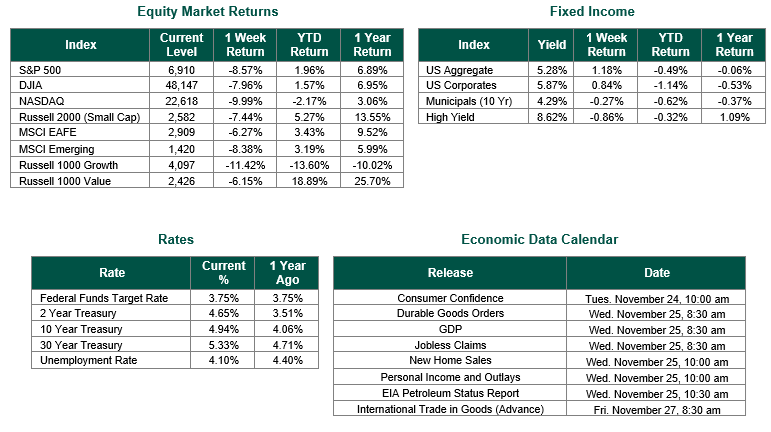
Global equity markets finished lower for the week. In the U.S., the S&P 500 Index closed the week at a level of 6910, representing a decrease of 8.57%, while the Russell Midcap Index moved -6.98% last week. Meanwhile, the Russell 2000 Index, a measure of the Nation’s smallest publicly traded firms, returned -7.44% over the week. As developed international equity performance and emerging markets were negative, returning -6.27% and -8.38%, respectively. Finally, the 10-year U.S. Treasury yield moved lower, closing the week at 4.94%.
Last week ended with the S&P 500 in correction territory. This week is starting on a very different note. This morning, NVIDIA Corporation (NVDA) announced that its board has unanimously reinstated Jensen Huang as President, CEO, and board member (not Chair), effective immediately. The decision comes 11 days after his resignation and only days after the board said on its earnings call that it did not intend to bring him back. The board said it was satisfied with Mr. Huang’s candor and ability to lead, and that input from senior levels of the U.S. government left it confident his return poses no national security risk. It followed a weekend in which President Trump publicly urged the board to rehire him. Colette Kress will continue as Chief Financial Officer, and Harvey Jones will remain Chair.
Markets responded immediately as of 9:10 a.m. ET, S&P 500 futures were up roughly 4%, Nasdaq 100 futures were up more than 6%, and Dow futures were up about 2.4%. Nvidia (Ticker: NVDA) traded nearly 29% above Friday’s close in premarket trading, recovering almost all of last week’s decline. The rally extended across the AI supply chain. Taiwan Semiconductor (Ticker: TSM) and Micron Technology (Ticker: MU) were each up more than 15%, while AI infrastructure names such as Dell Technologies (Ticker: DELL) and Vertiv Holdings (VRT) rose roughly 20%. The large cloud platforms were up 4% to 7%, and Anthropic (ANT) gained about 6%. Treasury yields were little changed, with the 10-year yield near 4.95%. In other news this morning, CrowdStrike Holdings (Ticker: CRWD) agreed to acquire Zscaler (Ticker: ZS) in an all-stock deal valued at approximately $43.9 billion.
Why does one executive matter this much? In our view, Huang’s return removes the single largest source of uncertainty hanging over the AI trade, as nothing in last week’s selloff pointed to weaker AI demand. Nvidia’s third-quarter revenue rose 103% from a year ago to $115.8 billion, its fourth-quarter guidance of $130 billion topped consensus estimates near $125 billion, and its new Vera Rubin platform is shipping in the fastest product ramp in the company’s history. What investors questioned was execution without its founder and what the removal of Juang, who became the face of AI, would mean for the future of the AI revolution. That question now has an answer…at least for now. We believe the AI revolution is back in play, and the focus can return to the fundamentals that have driven the buildout from the start. However, more volatility likely lies ahead, as investors will continue to probe a perceived “AI bubble” and further investigations into Nvidia remain.
That matters because last week was painful. The S&P 500 Index fell for seven straight sessions and posted its worst week since April 2025, closing 11.6% below its October 6 record. The Nasdaq Composite dropped 10.0%, its largest weekly decline since March 2020, and the CBOE Volatility Index (VIX) nearly doubled to 35.89. Nvidia fell roughly 23%, its worst week since October 2008, after Reuters reported Friday that SEC enforcement staff are examining potential accounting issues at the company. However, such an inquiry does not, by itself, establish wrongdoing. Anthropic’s debut, the largest initial public offering on record, landed in the middle of it, pricing at $83 and finishing Friday at $88.91.
We would not call every risk resolved. The SEC review remains open, the board’s independent investigation will proceed to conclusion, and Nvidia is creating a new Chief Compliance Officer role. The Federal Reserve is also leaning toward a more hawkish stance. Minutes from the October FOMC meeting showed that some participants favored a hike in October, and almost all judged that further increases would likely be appropriate. Futures markets are pricing roughly a 97% probability of a 25 basis point hike at the December 8-9 meeting, according to CME Group. Fundamentals remain strong. According to FactSet, third-quarter S&P 500 earnings are growing at a blended rate of 32.9%, and the forward 12-month P/E ratio of 17.1 sits below its 5-year (19.8) and 10-year (19.1) averages.
Looking ahead, Wednesday brings the October PCE inflation reading, the Fed’s preferred inflation gauge, along with the second estimate of third-quarter GDP, durable goods orders, and jobless claims. Earnings from Dell Technologies, Workday and Hewlett Packard Enterprise will offer a fresh read on AI spending, and Black Friday kicks off the holiday shopping season. U.S. equity markets are closed Thursday for Thanksgiving and close early on Friday at 1:00 p.m. ET.
We wish you and your families a happy and healthy Thanksgiving. Best wishes to all for the week ahead!
Equity and Fixed Income Index returns sourced from Bloomberg on 11/20/26. Premarket futures and stock prices are as of 9:10 a.m. ET on 11/23/26. NVIDIA leadership changes are sourced from the company’s November 23, 2026 press release. Corporate earnings data are sourced from FactSet and company reports. Federal Reserve meeting minutes are sourced from the Federal Reserve. Future interest rate probabilities are sourced from CME Group FedWatch. Historical correction data are based on S&P 500 Index price data since 1950. International developed markets are measured by the MSCI EAFE Index, emerging markets are measured by the MSCI EM Index, and U.S. Large Caps are defined by the S&P 500 Index. Sector performance is measured using the GICS methodology.
Disclosures: Past performance does not guarantee future results. We have taken this information from sources that we believe to be reliable and accurate. Hennion and Walsh cannot guarantee the accuracy of said information and cannot be held liable. You cannot invest directly in an index. Diversification can help mitigate the risk and volatility in your portfolio, but does not ensure a profit or guarantee against a loss.
Hennion & Walsh Asset Management currently has allocations within its managed money program, and Hennion & Walsh currently has allocations within certain SmartTrust® Unit Investment Trusts (UITs) consistent with several of the portfolio themes and securities cited above.