Oil Volatility and AI Spending Concerns Set the Stage for a Pivotal Fed Week
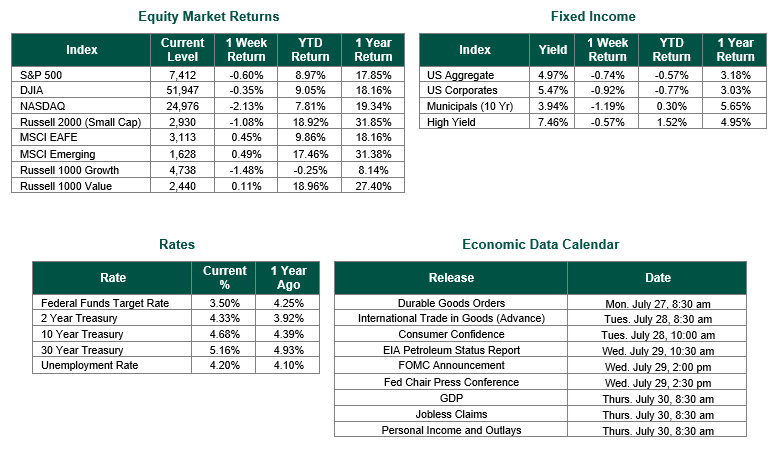
Global equity markets finished mixed for the week. In the U.S., the S&P 500 Index closed the week at a level of 7,412, representing a decline of 0.60%, while the Russell Midcap Index moved -0.03% last week. Meanwhile, the Russell 2000 Index, a measure of the Nation’s smallest publicly traded firms, returned -1.08% over the week. As developed international equity performance and emerging markets were positive, returning +0.45% and +0.49%, respectively. Finally, the 10-year U.S. Treasury yield moved higher, closing the week at 4.68%.
Last week was one of the most eventful of the summer, defined by the collapse of the U.S.-Iran ceasefire, a spike in oil prices and Treasury yields, and a wave of mega-cap technology earnings that revived concerns around the pace and profitability of AI capital spending. After a strong start on Tuesday, when the S&P 500 broke a three-day losing streak on the back of solid industrial and consumer discretionary earnings, sentiment deteriorated as the week progressed. Brent crude briefly eclipsed $100 per barrel after Houthi forces claimed attacks on Saudi Arabian tankers in the Red Sea, fueling concerns about an expansion of the Middle East conflict and pushing the 10-year Treasury yield to 4.68% by the close of the week, its highest level since the initial Iran war escalation in May. Equities rebounded modestly on Friday as oil pulled back toward the mid-$90s on reports that Pakistan, with support from China, was exploring a path to reviving negotiations between Washington and Tehran. Even with the Friday bounce, all three major indexes finished the week lower, with the Nasdaq bearing the brunt of the selling on the back of disappointing mega-cap technology earnings.
The most consequential geopolitical development of the week was the effective collapse of the U.S.-Iran ceasefire agreed to in June. U.S. Central Command carried out more than ten consecutive nights of strikes on Iran after President Trump declared the ceasefire “over,” while Iranian forces retaliated by targeting U.S. military assets across the region. The renewed conflict has meaningful implications well beyond the immediate humanitarian and geopolitical toll. Higher oil prices threaten to re-accelerate headline inflation just as the Federal Reserve had been gaining confidence in the disinflation trend, and futures markets have responded accordingly, with the implied probability of a September rate hike jumping from roughly 52% to more than 80% over the course of the week. The bond market has taken notice, with the 2-year yield touching a session high of 4.37% and the long end of the curve pushing meaningfully higher. Diplomatic backchannels remain active, and Friday’s late-week rally reflected genuine hope that mediated talks could resume, but the situation remains highly fluid.
Second-quarter earnings season also took center stage last week, and results have been generally strong. Of the roughly 66 S&P 500 companies that had reported by Tuesday, nearly 88% had topped bottom-line estimates, and consensus estimates now call for full-quarter S&P 500 earnings growth in excess of 20%, according to FactSet. That strong underlying picture, however, was overshadowed on Wednesday evening when Google and Tesla, two of the largest technology companies, reported after the close, revealing that free cash flow at both had turned negative as a result of aggressive spending on AI infrastructure, with expectations of increased future spending. The market’s reaction was swift, with both stocks down sharply on Thursday and the broader Nasdaq falling more than 2% in its worst single-day performance in more than a month. The concern is not that AI demand is fading, but rather that the sheer scale of capital investment required to compete may weigh on near-term profitability across the hyperscaler cohort. This dynamic could pressure valuations in a segment of the market that has led the rally for much of the past two years.
Looking ahead to the week, investors face what may be the single most important stretch of the summer. The FOMC concludes its two-day policy meeting on Wednesday, with markets expecting rates to be held steady but paying close attention to any shift in Chairman Warsh’s tone amid renewed inflation risks from higher oil prices. Thursday brings the first look at second-quarter GDP alongside the June Personal Consumption Expenditures (PCE) report, the Fed’s preferred inflation gauge, and the most important data point of the week. Earnings season also enters its most consequential phase, with several of the largest technology, cloud, and consumer companies reporting, providing investors with a much clearer read on both AI-related capital spending trends and the health of the broader consumer. Layered on top of it all, developments around the U.S.-Iran conflict and any progress toward renewed diplomatic talks will continue to drive day-to-day sentiment across oil, rates, and equities.
Best wishes to all for the week ahead!
Equity and Fixed Income Index returns sourced from Bloomberg on 7/24/26Corporate Earnings are sourced from FactSet. International developed markets are measured by the MSCI EAFE Index, emerging markets are measured by the MSCI EM Index, and U.S. Large Caps are defined by the S&P 500 Index. Sector performance is measured using the GICS methodology.
Disclosures: Past performance does not guarantee future results. We have taken this information from sources that we believe to be reliable and accurate. Hennion and Walsh cannot guarantee the accuracy of said information and cannot be held liable. You cannot invest directly in an index. Diversification can help mitigate the risk and volatility in your portfolio but does not ensure a profit or guarantee against a loss.