Stocks Look Past a Divided Fed as Big Tech Increases AI Spending
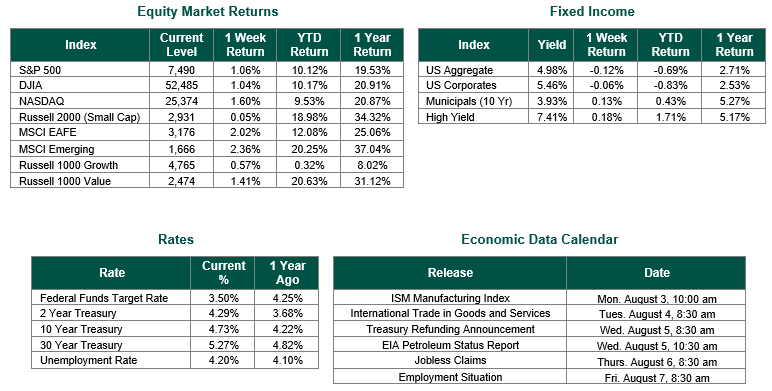
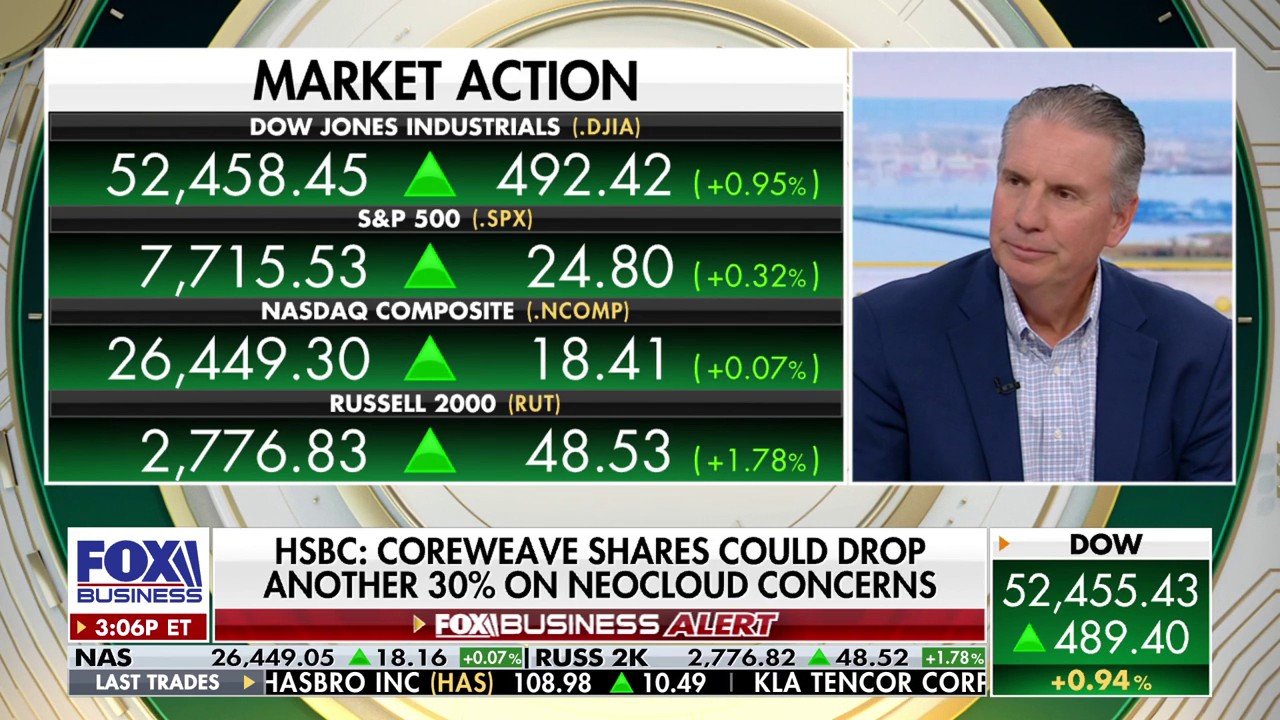
Global equity markets finished higher for the week. In the U.S., the S&P 500 Index closed the week at a level of 7,490, representing an increase of 1.06%, while the Russell Midcap Index moved +0.32% last week. Meanwhile, the Russell 2000 Index, a measure of the Nation’s smallest publicly traded firms, returned +0.05% over the week. As developed international equity performance and emerging markets were positive, returning +2.02% and +2.36%, respectively. Finally, the 10-year U.S. Treasury yield moved higher, closing the week at 4.73%.
Last week delivered the densest calendar of the summer, with a Federal Reserve decision, the first look at second-quarter GDP, the June reading on the Fed’s preferred inflation gauge, and earnings from four of the five largest companies in the S&P 500 all landing inside five trading sessions. The result was a tug-of-war between a bond market growing more worried about inflation and an equity market gradually growing more confident in the artificial intelligence buildout. Equities won. The Nasdaq led with a 1.60% gain, and the advance was broad, with international developed markets rising 2.02% and emerging markets adding 2.36%. Value again beat growth, 1.41% to 0.57%.
The Federal Open Market Committee (FOMC) left the federal funds target range unchanged at 3.50% to 3.75% on Wednesday, a fifth consecutive hold, but the vote was the real story. Three regional Fed presidents, Beth Hammack, Neel Kashkari, and Lorie Logan, dissented in favor of raising rates by 25 basis points, resulting in a contentious 9-3 split. Chairman Warsh called the hold especially prudent given the uncertainty facing the Committee, stressed that the Fed has no soft or implicit inflation target, and summed up the debate by saying he had asked for a “good family fight” and gotten one. The long end of the yield curve took the hawkish-leaning tone to heart. The 30-year U.S. Treasury yield touched 5.24% on Wednesday, its highest level since July 2007, and ended the week at 5.27%, while the 10-year U.S. Treasury closed at 4.73%, its highest weekly close in more than a year. Higher oil prices, heavy U.S. Treasury supply, and a FOMC now debating a hike rather than a cut all point the same way for long-duration bonds, and the U.S. Aggregate Index lost 0.12% on the week.
Last week’s economic data gave the Fed’s patient majority some plausible cover. Real GDP grew at a 1.5% annualized rate in the second quarter, according to the advance estimate, down from 2.1% in the first quarter, on gains in consumer spending, investment, and exports. Core Personal Consumption Expenditures (PCE), the Fed’s current preferred gauge of inflation, eased to 3.3% year over year in June from 3.4% in May, and headline PCE decelerated more sharply as energy prices fell 5.9% and gasoline dropped 9.2% during the brief pause in Middle East hostilities that took place. Slower growth and slightly cooler inflation kept the Committee on hold, though core inflation at 3.3% remains well above target, which is why three members presumably wanted to move the other way.
Corporate earnings results were the decisive catalyst for the week, landing as a direct rebuttal to the AI spending anxiety that punished Alphabet and Tesla the week prior. With 61% of the S&P 500 index reported, 86% of S&P 500 companies have beaten bottom-line estimates, on track for the highest positive surprise rate since the second quarter of 2021, and blended earnings growth for the quarter stands at 47.4%, or 28.8% excluding Alphabet and Amazon, according to FactSet. Microsoft rallied roughly 15% on Thursday, and Amazon surged about 15% on Friday, driven by strong cloud and chip results, while Apple fell about 7% on softer services and China revenue. The figure that mattered most was the combined capital spending guidance from the four hyperscalers, now pointing to $720 billion to $745 billion of capital projects in 2026. What looked like a threat to free cash flow in mid-July was received as confirmation of durable end-demand, and the beneficiaries of that spending across the power, cooling, networking, and semiconductor supply chains remain the most direct way to participate.
Looking ahead to this week, the labor market returns to center stage. Friday brings the July Employment Situation report, easily the most consequential release on the calendar, with the unemployment rate at 4.2%, from 4.1% a year ago. Before that, the ISM Manufacturing Index arrives Monday, international trade data Tuesday, and the Treasury Refunding Announcement Wednesday, which will draw more attention than usual given where long-end yields are trading, followed by jobless claims Thursday. Earnings season also rolls on with a heavy slate of industrial, energy, and consumer names that will show whether technology’s strength extends to the rest of the market. With no Fed meeting until September 15 – 16, when the Committee also publishes an updated dot plot (we believe), the incoming data will carry outsized weight, and the path of oil prices remains a live risk.
Best wishes to all for the week ahead!
Equity and Fixed Income Index returns sourced from Bloomberg on 7/31/26. Corporate Earnings are sourced from FactSet. International developed markets are measured by the MSCI EAFE Index, emerging markets are measured by the MSCI EM Index, and U.S. Large Caps are defined by the S&P 500 Index. Sector performance is measured using the GICS methodology.
Disclosures: Past performance does not guarantee future results. We have taken this information from sources that we believe to be reliable and accurate. Hennion and Walsh cannot guarantee the accuracy of said information and cannot be held liable. You cannot invest directly in an index. Diversification can help mitigate the risk and volatility in your portfolio but does not ensure a profit or guarantee against a loss.