Strong Jobs Report Raises Rate Hike Probabilities
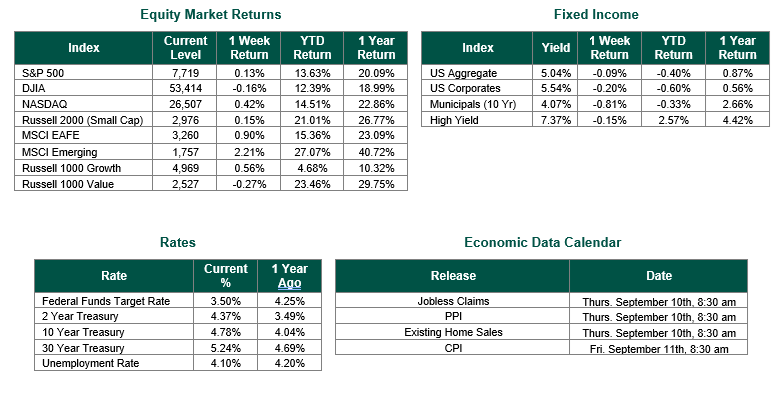
Global equity markets finished mixed for the week. In the U.S., the S&P 500 Index closed the week at a level of 7719, representing an increase of 0.13%, while the Russell Midcap Index moved -0.38% lower last week. Meanwhile, the Russell 2000 Index, a measure of the Nation’s smallest publicly traded firms, returned 0.15% over the week. As developed international equity performance and emerging markets were positive, returning +0.90% and +2.21%, respectively. Finally, the 10-year U.S. Treasury yield moved higher, closing the week at 4.78%.
Last week marked a significant shift in the market narrative, as renewed hostilities in the Middle East, a surge in oil prices, and a stronger-than-expected August jobs report drove Treasury yields to multi-year highs and revived debate over the trajectory of Federal Reserve policy heading into next week’s September FOMC meeting. Despite the turbulence beneath the surface, equity markets proved remarkably resilient.
The most significant economic release of the week was Friday’s August employment report, which came in dramatically stronger than expected and effectively reset expectations for the Federal Reserve. Nonfarm payrolls rose by 162,000 in August, well above the consensus estimate of roughly 53,000 and the strongest single-month gain since March. Just as importantly, prior months were revised meaningfully higher, with July revised from a loss of 23,000 jobs to a gain of 21,000, and June revised up from 20,000 to 31,000, adding a combined 55,000 jobs to the recent trend. The unemployment rate held steady at 4.1%, labor force participation was unchanged at 61.4%, and average hourly earnings rose 0.3% month-over-month and 3.1% year-over-year, both roughly in line with expectations but below current inflation levels. Taken together, the report presented a “goldilocks” mix of stronger hiring without a meaningful uptick in wage pressure, but it fundamentally changes the setup heading into the September FOMC meeting. Just three weeks ago, following the soft July payrolls print, futures markets were positioned for the Fed to remain on hold or even begin cutting rates before year-end. Following Friday’s report, the probability of a September rate hike has climbed back into meaningfully positive territory, and the divided committee that produced three dissents in July now appears to have a stronger voice.
The reacceleration in oil was equally consequential. Renewed fighting between the United States and Iran flared up over the course of the week, and Iran’s continued posture around the Strait of Hormuz kept crude oil under pressure throughout the week. WTI closed above $91 per barrel on Friday, up roughly 10% from about $83 the week prior, and marked its highest weekly close since May. In addition, Brent crude oil prices are rising near $100 a barrel again. The move higher in oil is important on two fronts. First, it directly threatens to reintroduce headline inflation pressure just as recent CPI reports had shown signs of stabilization. Second, it complicates the Fed’s calculus considerably, forcing policymakers to weigh whether energy-driven price pressures warrant a tightening response even as the underlying disinflation trend continues. The combination of stronger jobs, higher oil, and rising yields has clearly shifted the balance of risks back toward the hawkish end of the spectrum.
Beyond the macro backdrop, the week also delivered a notable corporate leadership development. On Monday, September 1, John Ternus formally succeeded Tim Cook as Chief Executive Officer of Apple, ending Cook’s 15-year tenure at the helm. Cook will remain at the company as Executive Chairman. Under Cook’s leadership, Apple grew from a roughly $350 billion market capitalization to more than $4.5 trillion, and annual revenue expanded from $108 billion to more than $400 billion. Ternus, previously the company’s Senior Vice President of Hardware Engineering, inherits a company with unmatched profitability and brand strength, but also one facing arguably its most significant strategic challenge since the launch of the iPhone: closing the perceived gap in generative artificial intelligence (AI) relative to Nvidia, Microsoft, Google, and other technology peers that have dominated the AI narrative. How Ternus navigates the AI transition will be one of the most closely watched corporate storylines of the coming years.
Looking ahead to the holiday-shortened week, all eyes will be on the August inflation reports, with the Producer Price Index and Consumer Price Index both scheduled for release. A hotter-than-expected reading would materially raise the probability of a September rate hike and put further pressure on the long end of the curve, while an in-line or cooler print would provide some relief and keep the door open to a hold. Beyond the data, ongoing developments in the Middle East, oil price action, and any Fed commentary during the pre-meeting blackout period will continue to drive day-to-day sentiment across asset classes.
Best wishes to all for the week ahead!
Equity and Fixed Income Index returns sourced from Bloomberg on 9/4/26. Future interest rate probabilities are sourced from CME Group FedWatch. August Jobs data sourced from the Bureau of Labor Statistics on 9/4/26. International developed markets are measured by the MSCI EAFE Index, emerging markets are measured by the MSCI EM Index, and U.S. Large Caps are defined by the S&P 500 Index. Sector performance is measured using the GICS methodology.
Disclosures: Past performance does not guarantee future results. We have taken this information from sources that we believe to be reliable and accurate. Hennion and Walsh cannot guarantee the accuracy of said information and cannot be held liable. You cannot invest directly in an index. Diversification can help mitigate the risk and volatility in your portfolio, but does not ensure a profit or guarantee against a loss.