Weak Payrolls and Softer Inflation Change Rates Outlook
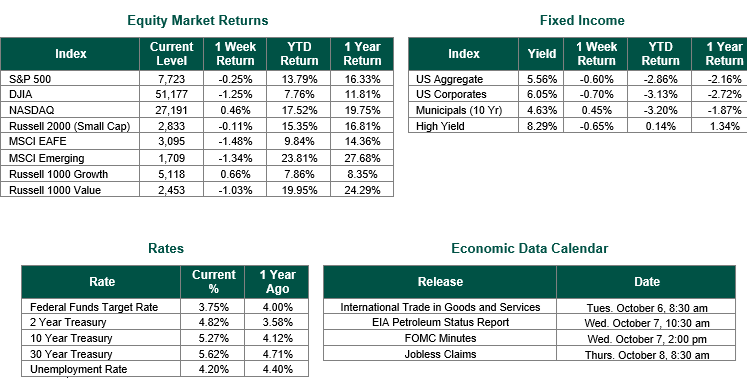
Global equity markets finished mixed for the week. In the U.S., the S&P 500 Index closed the week at a level of 7723, representing a decrease of 0.25%, while the Russell Midcap Index moved +0.02% last week. Meanwhile, the Russell 2000 Index, a measure of the Nation’s smallest publicly traded firms, returned -0.11% over the week. As developed international equity performance and emerging markets were negative, returning -1.48% and -1.34%, respectively. Finally, the 10-year U.S. Treasury yield moved higher, closing the week at 5.27%.
Last week saw the release of a series of important macroeconomic releases that altered the outlook for U.S. monetary policy for the remainder of this year…at least for the time being. The primary focus of market participants was directed toward the September employment situation summary from the U.S. Bureau of Labor Statistics (BLS), which highlighted a cooling in the domestic labor market. Total non-farm payroll employment rose by just 29,000 jobs in September, falling short of the consensus estimate of approximately 90,000 jobs. This lower result represented a large deceleration from the previous month’s strong pace, which was also revised downward. Adding to the downbeat tone were the revisions to prior periods. August’s initially reported gain of 162,000 jobs was revised downward to 133,000, while July’s payroll numbers were trimmed by 31,000, shifting from a minor expansion of 21,000 to a net loss of 10,000 jobs. Together, these adjustments stripped 60,000 jobs from previously estimated data.
Further details within the household survey confirmed this softer labor market environment. The headline unemployment rate ticked upward to 4.2% in September, compared to both the prior month’s level of 4.1% and the consensus expectation that it would hold steady at 4.1%. Economists noted that the rise in unemployment was largely due to an influx of new participants entering the labor force rather than widespread layoffs. Wage inflation also showed signs of moderation, easing some inflationary anxieties. Average hourly earnings for private non-farm employees crept up by just 5 cents, or 0.1% on a month-over-month basis, bringing year-over-year wage growth down to 3.0%. This result marked a slight step down from the 3.1% annual wage growth recorded in August and represented the lowest annual expansion rate observed since May 2021. The average workweek held steady at 34.4 hours, signaling that while businesses are slowing their recruitment efforts, they are maintaining stable operational schedules for existing personnel.
The August Personal Income and Outlays report was also released last week, offering a comprehensive look at consumer behavior and preferred inflation gauges. Personal income increased by 0.2% on a monthly basis, which notably lagged behind the consensus projection of a 0.5% gain. Despite this slower income growth, consumer spending remained surprisingly robust, with personal consumption expenditures surging by 0.9%, matching consensus estimates. This spending surge was driven largely by outlays on energy goods, autos, and food services, pushing the personal saving rate down to 4.1%. On the inflation front, the overall Personal Consumption Expenditures (PCE) price index increased by 0.3% from the preceding month, resulting in a year-over-year headline rate of 3.4%. Meanwhile, the critical core PCE price index, the Federal Reserve’s preferred gauge of inflation, rose 0.2% in August, bringing its trailing 12-month inflation rate to 3.0%. Both metrics came in lighter than earlier projections, aided by extensive benchmark revisions that revealed inflation throughout the year was actually lower than previously measured.
Collectively, these macroeconomic indicators helped to reshape expectations regarding the future path of interest rates. According to the CME Group FedWatch Tool, the probability of the FOMC raising interest rates at its upcoming October 27–28 meeting collapsed dramatically following the weak jobs report. One week prior, interest rate futures had priced in a hefty 64.2% probability of a 25-basis-point increase, driven by hawkish sentiment. However, following the week’s cooler jobs data and softer core PCE figures, the tool indicated that the probability of the FOMC leaving its benchmark interest rate target unchanged in October skyrocketed to 82.3%. Looking further out to the final meeting of the year in December, investors have not completely abandoned the prospects of policy tightening. The data reflects a dominant 68.7% cumulative probability of a 25-basis-point rate hike, suggesting that while the committee will likely opt for a temporary pause in October to evaluate incoming data, a final year-end adjustment remains a possibility, though still unlikely in our view.
Best wishes to all for the week ahead!
Equity and Fixed Income Index returns sourced from Bloomberg on 10/02/26. The Employment Situation Report is sourced from the U.S. Bureau of Labor Statistics. Jobless Claims were sourced from the U.S. Department of Labor. The August Personal Income and Outlays report is sourced from the U.S. Bureau of Economic Analysis. Future interest rate probabilities are sourced from CME Group FedWatch. International developed markets are measured by the MSCI EAFE Index, emerging markets are measured by the MSCI EM Index, and U.S. Large Caps are defined by the S&P 500 Index. Sector performance is measured using the GICS methodology.
Disclosures: Past performance does not guarantee future results. We have taken this information from sources that we believe to be reliable and accurate. Hennion and Walsh cannot guarantee the accuracy of said information and cannot be held liable. You cannot invest directly in an index. Diversification can help mitigate the risk and volatility in your portfolio, but it does not ensure a profit or guarantee against a loss.